You can also listen to the show on your phone by calling (917) 388-4520.
You can call in with questions during the 2nd half hour, by dialing (917) 388-4520, then pressing 1.
This show will be archived so you can listen to it anytime.
________________________________________
Carol Walker, Dir. of Field Documentation and R.T. Fitch, Pres. and co-Founder of Wild Horse Freedom Federation host tonight’s show. Our guest is Charlotte Roe, Founder of Wild Equid League of Colorado and Advisor to The Cloud Foundation. We’ll be detailing BLM’s cruel experiments on wild horses and burros that are a launching pad for widespread use as “population suppression” on the remaining wild horses and burros. These heartless experiments are the endgame for wild horses and burros on our public lands. We’ll also tell you how you can help to stop these experiments.
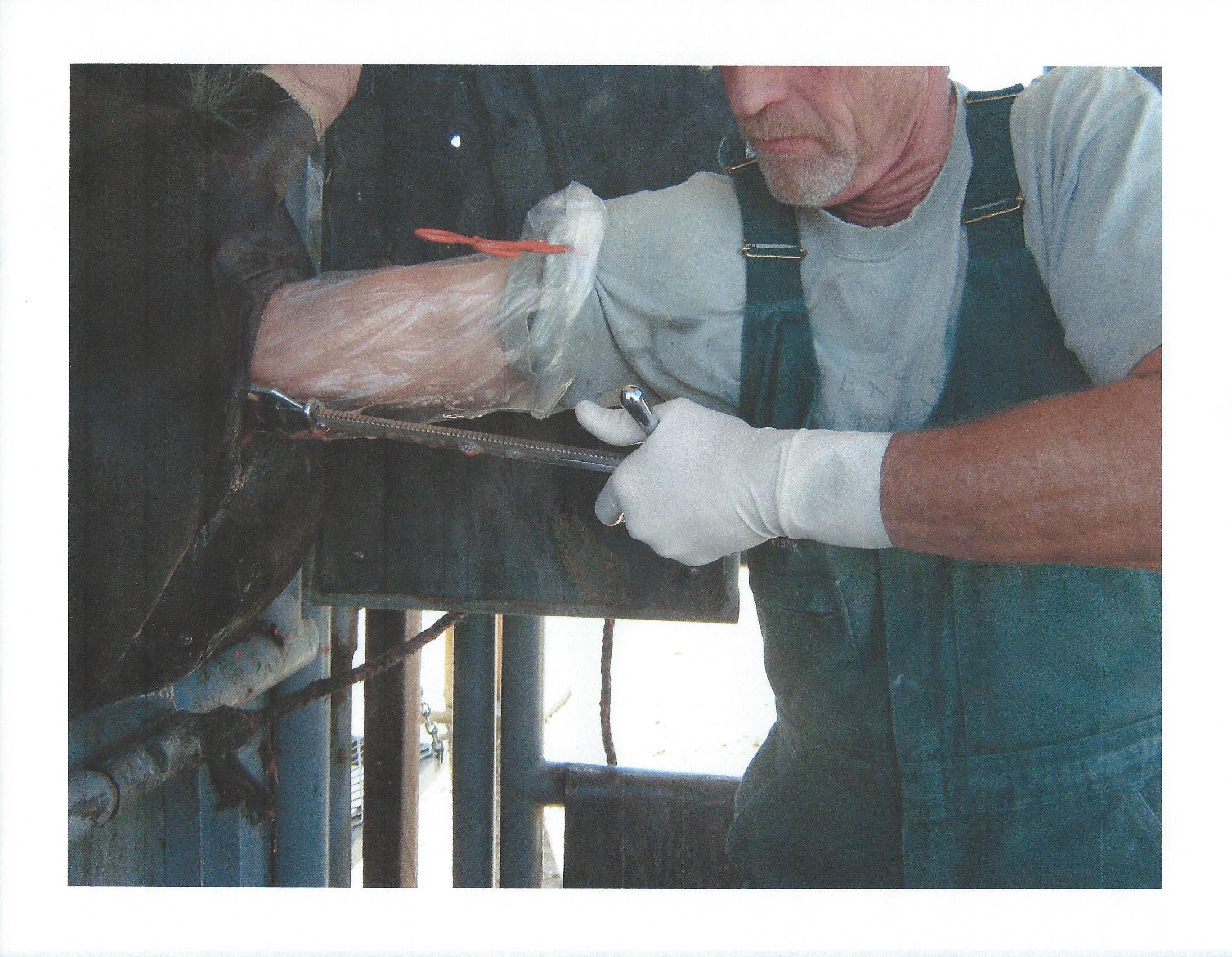
BLM experiments include senseless laser ablation on 8 month old foals and, with along with partner Oregon State University, risky ovariectomies via colpotomy (pictures below) performed by veterinarian Leon Pielstick.
To contact us: ppj1@hush.com, or call 320-281-0585 More
Carol and Susan will discuss how the sanctuary was started in 1988, the importance of educating the public about wild horses, the challenges facing wild horses today, why we need private Sanctuaries, programs offered by the Sanctuary, the Adobe Appys, and how you can visit and support the Black Hills Wild Horse Sanctuary.
You can also listen to the show on your phone by calling (917) 388-4520.
You can call in with questions during the 2nd half hour, by dialing (917) 388-4520, then pressing 1.
This show will be archived so you can listen to it anytime.
_____________________________________________
Tonight’s show will be hosted by Marjorie Farabee, Dir. of Wild Burro Affairs for Wild Horse Freedom Federation, Equine Mgr. of Todd Mission Ranch (TMR Rescue) & founder of Wild Burro Protection League. Marjorie will be joined by local wild burro advocates, all of whom are fighting to save the wild burros of the Black Mountain Herd Management Area in Arizona.
Please join us in sending a message to Arizona to keep their hands off of our wild burros. The mountain canary’s song is about to be silenced forever if we are not proactive in stopping these rogue agencies (BLM and Arizona Game & Fish Dept.) from gathering them all under the pretense of overpopulation. There is not an overpopulation of burros, nor could the BLM prove it with their aerial count. This emergency show has been set up so that people will learn about our burros and how to protect them. There are strong voices of haters joining together to spell the end of this magnificent herd from Black Mountain HMA. We cannot let this happen.
or listen to the show live on your phone by calling (917) 388-4520.
This is a one and a half hour show. It will be archived so you can listen to it anytime.
_____________________________________________
Our guests Wednesday night are the Board of Directors of Wild Horse Freedom Federation (R.T. and Terry Fitch, Carol Walker, Marjorie Farabee, Dawn Reveley and Debbie Coffey), along with special guests John Holland, President of Equine Welfare Alliance, Ginger Kathrens,
photo by Terry Fitch of Wild Horse Freedom Federation
Activists from all across the nation are converging in Denver, Colorado this October for the Stop the Frack Attack National Summit. At the summit, anti-fracking activists and front line communities will come together to build our movement and discuss how we are going to put an end to fracking nationwide. There will be numerous workshops on organizing, outreach, non-violent direct action, community rights building, fundraising, and much more.
The Stop the Frack Attack National Summit is being held in Denver, Colorado from October 3rd – 5th. For more information and to RSVP, please visit: http://bitly.com/FrackingSummit
This summit will also be the first non-violent direct action training opportunity for Californians who have taken the Pledge of Resistance. If you haven’t already taken the pledge to resist extreme oil & gas extraction in California, please sign on here: http://bitly.com/ResistFracking.
There are scholarships still available for folks who can’t afford some of the costs, so if you are free during the first weekend of October, please consider joining us in Colorado! If you have any questions, please feel free to email me at damienluzzo33@gmail.com.
Wild Horse Freedom Federation Partners with The Cloud Foundation to Block BLM’s Plan to Zero Out Colorado’s Unique West Douglas Herd
Pinehurst, TX – Since 2010 wild equine advocacy groups Wild Horse Freedom Federation (WHFF) and The Cloud Foundation (TCF) have consistently worked together in a unified effort to thwart the Bureau of Land Management’s (BLM) attempts to totally remove Colorado’s West Douglas herd from their rightful range for the exclusive benefit of “Welfare” ranchers and special interest groups.
Although this legal battle has been ongoing for almost 20 years the BLM has, as of late, accelerated their efforts to destroy this federally protected, historic herd so that private cattle owners and extraction interests can declare the public land to be their own.
Citing that the wild horses are damaging the range due to over grazing the BLM has failed to acknowledge that the number of horses pale compared to the sizable herd of private, “welfare” cattle that are allowed to graze on the public land for the bulk of the year at mere pennies a day.
“Using the BLM’s own statistics, the wild horses are out numbered by a minimum of 4 to 1 by the welfare cattle allowed to graze on the horse’s range.” states R.T. Fitch, President and cofounder of WHFF, “The concept of the Federal Government destroying this herd to line the pockets of a few of their bedfellows ought to spark outrage in each and every American’s heart and soul. Enough is enough and we are making a stand.”
Renowned equine photographer and Director of Field Documentation for WHFF, Carol Walker agrees; “The BLM must not be allowed to zero out this herd simply because it is ‘inconvenient’ to manage, or because it is pandering to cattle ranchers and extraction companies. This would set a very damaging precedent for our few remaining wild horses and burros.”
The BLM intends to commence with their removal operation next month.
Wild Horse Freedom Federation (WHFF) is a registered, Texas non-profit corporation with 501c(3) status in all 50 states. WHFF puts people between America’s wild equids and extinction through targeted litigation against governmental agencies whose documented agendas include the eradication of wild horse and burros from public, federal and state lands. WHFF is funded exclusively through the generosity of the American public.
You can also listen to the show on your phone by calling (917) 388-4520.
You can call in with questions any time after I introduce Ginger, by dialing (917) 388-4520, then pressing 1.
This is a 1 hour show. It will be archived so you can listen to it anytime.
_____________________________________________
Our guest tonight is Ginger Kathrens, Founder and Executive Director of The Cloud Foundation. Ginger will be giving us an update on Cloud the Stallion and the wild horses in the Pryor Mountains in Montana. Ginger will also talk about the BLM’s plans to sterilize wild horses & burros.
Cloud walked up to Ginger’s car, perhaps to admire his likeness in the sign.
Carol will be talking about Bureau of Land Management (BLM) plans to STERILIZE wild horses, including the FIELD SPAYING OF WILD MARES. (Due to the mismanagement of the BLM, most wild horse herds are not even viable.)
Leon Pielstick, DVM, inserting a chain ecraseur via colpotomy incision
Please submit a comment to the Bureau of Land Management (BLM) in your own words, asking that the minimum rate per acre for oil and gas leasing be MUCH higher than $2 an acre, and ask the BLM to remove caps established by current regulations on civil penalties that may be assessed under the Federal Oil and Gas Royalty Management Act.
Most importantly, be sure to demand that the BLM NOT approve any more land for oil & gas development/leasing on Wild Horse & Burro Herd Management Areas (HMAs) (since there supposedly isn’t enough water and forage for wild horses and burros on their federally protected HMAs).
(photo: BLM) BLM Extends Public Comment Period to June 19, 2015 on Oil and Gas Royalty Rulemaking
SOURCE: goldrushcam.com
May 29, 2015- WASHINGTON – The Bureau of Land Management (BLM) announced today that it is extending the public comment period on its Advance Notice of Proposed Rulemaking (ANPR) to seek public comment on potential updates to BLM rules governing oil and gas royalty rates, rental payments, lease sale minimum bids, civil penalty caps and financial assurances.
Notice of the two-week extension, which extends the comment period deadline to June 19, 2015, will be published in the Federal Register on June 3, 2015.
Modernizing the BLM’s royalty rate structures can provide greater flexibility, especially given the dramatic growth of oil development on public and tribal lands, where production has increased in each of the past six years, and combined production was up 81 percent in 2014 versus 2008. Potential changes to BLM’s regulations would also respond to concerns expressed by the Government Accountability Office (GAO), Interior’s Office of Inspector General, and others that the BLM’s existing rules lack flexibility and could be causing the United States to forgo significant revenue to the detriment of taxpayers.
The GAO has repeatedly concluded that the BLM’s regulations do not provide a reasonable assurance that the public is getting appropriate fair share of the revenue from these resources. The BLM’s current rules lack the flexibility to offer new competitive leases at higher royalty rates.
The ANPR also addresses the value of these resources by inviting comment on how the BLM might update its rules regarding the minimum acceptable bid that must be paid by parties seeking a lease at auction, and the annual rental payments that are due after a lease is obtained. The current minimum acceptable auction bid is $2 per acre, which is well below the rate at which most parcels sell, suggesting that the rate could be higher. After obtaining a lease, a lessee is currently required to make annual rental payments until the lease starts producing oil or gas. These rental rates currently are $1.50 per acre for the first five years and $2 for years five through 10. The ANPR invites comment on how rental payments might be better structured to incentivize diligent development of leased areas.
The BLM encourages the public to be actively engaged in this process by submitting comments on the revised proposed rule before June 19 in one of the following ways:
Mail: U.S. Department of the Interior, Director (630), Bureau of Land Management, Mail Stop 2134 LM, 1849 C St. NW, Washington, DC, 20240, Attention: 1004-AE41.
Personal or messenger delivery: Bureau of Land Management, 20 M. St. SE, Room 2134 LM, Attention: Regulatory Affairs, Washington, DC 20003.
Online at the Federal eRulemaking Portal: http://www.regulations.gov. Follow the instructions for submitting comments at this Website.
This is a 1 hour show. Call in with questions during the 2nd half hour.
Call in # (917) 388-4520
_____________________________________________
Our guest is Carol Walker, Dir. of Field Documentation for Wild Horse Freedom Federation who will talk about BLM’s plans to sterilize wild horses, the many deaths of the recently captured Wyoming “checkerboard” wild horses, the BLM’s plans that could, in essence, destroy the Pryor Mountains wild horse herds, and an update on the wild horses at the Black Hills Wild Horse Sanctuary. (photo above: wild horses in winter in Adobe Town, by Carol Walker)
Carol Walker
Carol is a plaintiff in the lawsuit that has been attempting to stop the BLM from removing over 800 wild horses from Adobe Town, Salt Wells Creek, and Great Divide Basin in Wyoming.
How could the BLM be “unaware” that a company is using a pipeline? (Another reason to wonder how closely the BLM actually monitors the range.) According to True Oil (True Companies), “Belle Fourche Pipeline is a liquids pipeline operator that gathers and transports crude oil in the Williston Basin of western North Dakota and the Powder River Basin of Wyoming.” To see a map of this pipeline in Wyoming, click HERE. According to an article in the Casper Star Tribune, True Companies have had many pipeline spills.
True Companies also owns 7True Ranches (ADA Ranch, Double Four Ranch, LAK Ranch, Rock River Ranch, Chalk Bluffs Ranch, HU Ranch, VR Ranch), 2 feedlots (LAK Feedlot, Wheatland Feedlot) and 2 Farms (LAK Farm, Wheatland Farm) in Wyoming. – Debbie
Almost a decade after Belle Fourche Pipeline Co., a True Oil company, told the Bureau of Land Management it was no longer using a pipeline 44 miles southeast of Buffalo, the pipeline leaked 25,200 gallons of crude oil onto public lands.
The company terminated its right of way permit in writing in 2006. At some point, without the knowledge of the federal agency, the company illegally resumed use of the pipeline, said Christian Venhuizen, BLM public affairs specialist.
Why and when the company continued to use the pipeline remains unanswered. Bob Dundas, environmental coordinator for Belle Fourche and Bridger pipelines, said he would forward the Buffalo Bulletin’s request for information and comment to someone who could answer questions related to permitting.
On May 20, 2014, Belle Fourche reported the oil spill to the BLM, after workers noticed oil seeping up from the ground, Dundas said. The BLM determined that Belle Fourche was in trespass, Venhuizen said, and fined Bridger Pipeline, a sister company, also owned by True Oil.
The BLM is now planning to do a “knowledge and values study” on wild horses & burros using focus groups. The focus groups are to include the usual special interest groups (the same ones that are so vocal against wild horses & burros on the BLM Resource Advisory Councils/RACs).
Most of us aren’t perusing the Federal Register on a daily basis, but an advocate alerted us to the notice below. We should all ask WHO will APPOINT/SELECT the people who will take part in these focus groups. The BLM proposes to have “guides” (a prepared agenda) for the groups, presumably to limit the topics you can talk about. The questions/discussions will then likely be designed to lead you to whatever predetermined outcome the BLM wants. Read HERE about the BLM and use of the Delphi Technique.
This is not free speech. Will the topics include the delay of the issuance of the investigation report of the 1,700 wild horses Tom Davis bought? Will the focus groups be updated on the current number of deaths of wild horses at the BLM’s Scott City, Kansas feedlot? Will the participants be able to review any vet reports or necropsy reports from the Scott City feedlot?
This undemocratic process seems to be a way for the BLM to feign interest in listening to the public, while in reality, it continues its efforts to contrive what could seem to the public to be some sort of a consensus.
I wonder if the BLM will ever have focus groups or advisory councils on wild horse & burro issues that are composed ONLY of real wild horse & burro advocates, who all care about the welfare of the wild horses and burros (instead of special interest “stakeholders” who focus on how to get rid of them). The comment period for this proposed focus group farce ends May 11, 2015. This is destined to be another unscientific “study” as the BLM continues to operate like a dog chasing its tail. – Debbie Coffey
Let’s say you own 245 million acres. And underneath that land are billions of dollars’ worth of minerals – gold, silver, copper, uranium and more. Would you let foreign companies in to tear up your land, put your water at risk and take those minerals without paying royalties?
You already are. That’s the amount of public surface land controlled by the U.S. Bureau of Land Management, the federal government’s biggest landholder. And companies that mine these lands are exempt from federal royalty payments.
And it’s happening right now. Take, for example, the Dewey Burdock uranium project in South Dakota. It encompasses 240 acres of public surface land, plus more than 4,000 subsurface acres of uranium-rich earth.
As of two months ago, a Hong Kong-based company had secured the right to mine and profit off that uranium, used to replenish nuclear power plants around the world, particularly in China. In November, Hong Kong’s Azarga Resources merged with Powertech to become Azarga Uranium and manage the Dewey Burdock project.
Azarga will pay no royalties to the United States government. Thanks to the Mining Law of 1872, which still governs uranium and other “hardrock” mining to this day, any company can extract and sell minerals from public lands without paying a cent in royalties to the federal government.
A spokesman for the mine, Mark Hollenbeck, points out that the mine will be paying South Dakota a severance tax, which is a tax on extracting nonrenewable resources.
Besides the royalties issue, some community members worry this mine will put their drinking water at risk. In-situ uranium mining by nature takes place where there is groundwater. The process involves injecting chemicals into the aquifer where the uranium ore is. The chemicals leach the uranium from the rock, and the uranium is then pumped to the surface. At Dewey Burdock, opponents are concerned that the radioactive, uranium-laden groundwater won’t be contained to the mining site.
Last week, the Nuclear Regulatory Commission released testimony from geologist Hannan LaGarry. LaGarry found serious flaws in the company’s analysis of the groundwater geology. He concluded that that there is a risk of groundwater contamination if the mine is allowed to go forward.
The mining company opposed the release of the testimony.
In the U.S., the aquifer by law must be restored to its previous condition when mining is finished. That means the water must be cleaned enough to put it back to its pre-mining uses.
CORRECTION: When this article originally posted, the incorrect information that Kevin Borba owned 330,000 acres was quoted from the Elko Daily Free Press (Thomas Mitchell). However, according to newly obtained information from the Eureka County Assessor, Kevin Borba owns 1,339.55 acres. This article has been updated to include this correction. ____________________________________________________
Fish Creek HMA roundup (photo: Bureau of Land Management)
Rancher Kevin Borba and Eureka County Commissioners filed the appeal with the Interior Board of Land Appeals on Friday, opposing the return of any of the 424 wild horses recently rounded up to the Fish Creek Herd Management Area (HMA) near Eureka, Nevada.
Report analyzes taxpayer bailout of U.S. public lands ranching [Part II of a series on ranchers]
by Vickery Eckhoff
Public lands livestock operators each cost taxpayers nearly a quarter of a million dollars in subsidies over the last decade. (AP Photo/Las Vegas Review-Journal, John Locher)
Five hundred million dollars[1]. That’s what 21,000[2] ranchers who graze their livestock on America’s iconic western rangelands are estimated to have cost US taxpayers in 2014 — and every year for the past decade. This averages out to an annual taxpayer subsidy of $23,809 per rancher — approximately a quarter of a million dollars each since 2005. So why does this small subset, representing just 2.7% of US livestock producers, protest the “welfare rancher” label?
The public lands grazing program is welfare.
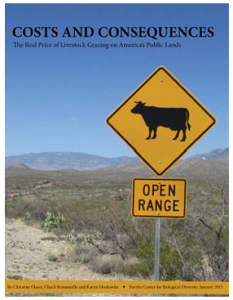
That $23,809 — and it’s a lowball figure — is a form of public assistance similar to other welfare programs. The only difference is, it doesn’t arrive as a check in the mail. It instead represents a loss covered by taxpayers: the very large difference between what public lands ranchers pay in fees to the US government and what public lands grazing costs taxpayers every year. But it’s still a subsidy, as a newly updated economic analysis, Costs and Consequences: The Real Price of Livestock Grazing on America’s Public Lands, makes clear. And the recipients aren’t low income; a large number are millionaires and some are billionaires and multi-billion dollar corporations. Cattle barons, if you will.
Public lands ranching costs western ecosystems, wildlife and taxpayers.
“Several federal agencies permit livestock grazing on public lands in the United States, the largest being the U.S. Department of the Interior’s Bureau of Land Management (BLM) and the Department of Agriculture’s United States Forest Service (USFS).
The vast majority of livestock grazing on BLM and USFS rangelands occurs in the 11 western states of Arizona, California, Colorado, Idaho, Oregon, Montana, New Mexico, Nevada, Utah, Washington and Wyoming.
Rangelands are non-irrigated and generally have vegetation that consists mostly of grasses, herbs and/or shrubs. They are different from pastureland, which may periodically be planted, fertilized, mowed or irrigated.”
However, the Department of Justice (DoJ) only issued a letter of declination. A declination decision is generally viewed to mean that the DoJ , in the exercise of its prosecutorial discretion, declines to prosecute or bring an enforcement action.
So, the issue of a current BLM contractor selling wild horses to a kill buyer, most likely for slaughter, was just swept under the rug.More
Michael Moss’ powerful New York Times’ investigation into the United States Department of Agriculture’s Meat Animal Research Center (“U.S. Research Lab Lets Livestock Suffer In Quest For Profit”) predictably outraged readers. The collective angst came not just because of the center’s ghoulish and inept experimentation; not just because the research animals suffered to boost profits in the livestock industry; but because the public learned that taxpayers had footed the bill — and had been doing so — for fifty years.
Compare that discovery to the recent media attention given to a very similar program, one involving even more animals, conducted to boost livestock industry profits, costing even more taxpayer dollars, and degrading millions of acres of public rangelands in the American West: The Bureau of Land Management’s Wild Horse and Burros Program (WHB).
The news media regularly covers this program. Articles about wild horses appear daily, in fact. So why is the public incensed over the U.S. Department of Agriculture’s Meat Animal Research Center while the WHB program goes ignored?
The difference is in the reporting. Coverage of the Meat Animal Research Center (which we review here) was initiated by government whistleblowers within the research facility. An experienced investigative reporter subsequently spent a year researching the claims, largely through Freedom of Information Act requests. Federal and corporate perspectives were handled with appropriate suspicion.
Coverage of the WHB program, on the other hand, is typically sourced almost entirely from the Bureau of Land Management (BLM) and the industries benefiting economically from wild horse roundups: notably, private ranchers holding public grazing permits (though mining and energy development companies profit, too).
If Moss, in his reporting on the Meat Animal Research Center, had turned to the USDA’s web site and livestock producers to ask about doing research to boost industry profits, would anyone ever know about “easy-care sheep” and lambs left to perish in rainstorms courtesy of unknowing taxpayers? Of course not.
Non-industry sources comprise less than 8 percent of the articles’ collective text. The other 92 percent is all industry boilerplate. Enders’ loyalty to the ranchers’ perspective even creeps into her word choices. Notably, she uses rancher lingo to refer to wild horses, calling them “feral.” Her point of view is clear, and it’s 92% bull.
This kind of source bias would be understandable coming from a reporter for a beef industry trade publication. But Enders is a reporter for a major media outlet.
An over-reliance on federal and industry sources is problematic not just for animals, but for the consumers who eat them (and care about their welfare). Enders’ piece notably fails to answer the two questions posed in her own headline: a) why you should eat horse meat, and b) why you can’t.
One reason why you can’t eat horse meat is that some states ban it outright. The larger reason is that Congress passed an amendment banning inspections in horse slaughter plants, preventing them from opening. These facts are well documented in the media, as this January 17, 2014 NPR article exemplifies.
A bipartisan majority supported this amendment because the drugs horses routinely take are banned in food animals. Furthermore, there is no proper system in place to track these drugs, making it impossible to keep tainted horse meat out of the food chain. As a reporter, Enders should have known these facts. And reported them.
Enders’ suggestion that wild horses would be suitable alternatives is equally misinformed. For one thing, wild horses in BLM holding facilities are wormed and vaccinated (therefore not free of drugs banned in meat animals). For another, Congress prohibits the slaughter of wild horses. As a reporter, Enders should have known that, too.
Why did she not? Simple: industry, whom she relied on for her reporting, doesn’t offer this information. The only place you’ll learn about the intricacies of horse slaughter (and wild horse round-ups) is from advocacy groups: the very people Enders and Philipps gave one word of text to for every eleven it handed to ranchers and the BLM.
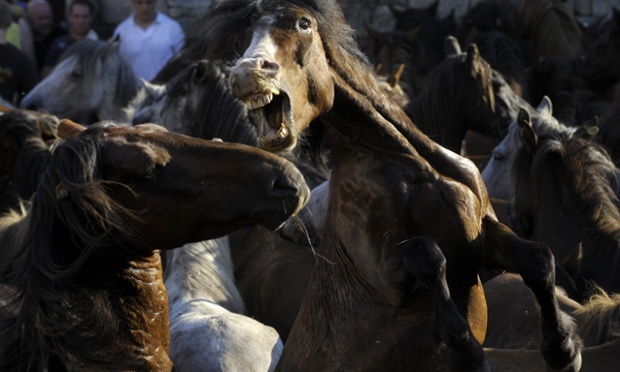
Again, sources matter. Consider, as a final point, the dramatic photo in Enders’ piece showing wild horses fighting, one with its teeth bared and the caption, “Overcrowding on the frontiers of the American west could lead to a depletion of natural resources for wild horses.”
The photo confirms the article’s bias. The problem is that it doesn’t depict wild horses fighting over depleted natural resources in the American West at all. Rather, it was taken in Sabucedo, Spain during a 400-year-old “horse festival” called rapa das bestas, a macabre ritual in which wild horses are driven down from the mountains, wrestled to the ground to have their manes and tails trimmed, and “corralled into a village where they face aloitadores or fighters in this man vs. animal challenge – minus weapons, just bare hands and hooves.”
There’s a reason why complex topics — such as Moss’ investigation into the Meat Animal Research Center and wild horses rounded up by the BLM — require thoughtful digging and reporting. The alternative — an easy reliance on self-interested federal and industry sources — keeps the public in the dark about the inept, incomprehensible and inhumane things that the government is doing with its money. Journalists should not be abetting that corruption. They should be exposing it.
BLM’s Welfare Ranching Bedfellows come with a huge price tag…
WASHINGTON— A new analysis finds U.S. taxpayers have lost more than $1 billion over the past decade on a program that allows cows and sheep to graze on public land. Last year alone taxpayers lost $125 million in grazing subsidies on federal land. Had the federal government charged fees similar to grazing rates on non-irrigated private land, the program would have made $261 million a year on average rather than operate at a staggering loss, the analysis finds.
Click Image to Download Full Report
The study, Costs and Consequences: The Real Price of Livestock Grazing on America’s Public Lands, comes as the Obama administration prepares Friday to announce grazing fees for the upcoming year on 229 million acres of publicly owned land, most of it in the West. The report was prepared by economists on behalf of the Center for Biological Diversity.
“Public lands grazing has been a billion-dollar boondoggle over the past decade and hasn’t come close to paying for itself,” said Randi Spivak with the Center for Biological Diversity. More
Some interesting background before you read the news article below: It seems that if we even just look at one grazing allotment on the Pine Nut HMA, the Buckeye Allotment, BLM allows about 375 cattle (and don’t forget that cow-calf pairs only count as one in BLM fuzzy math, so this number could be doubled) to dine on public lands for about 5 1/2 months out of the year.
Also, in BLM’s Oct. 2010Environmental Assessment to roundup wild horses in the Pine Nut HMA in Nevada, the BLM claimed there were 148 horses within the Pine Nut HMA and they were going to treat 45 mares with PZP. So, that would leave about 103 wild horses without fertility control in Oct. 2010. So even if ALL STALLIONS GAVE BIRTH, and using BLM’s questionable estimate of a 25% increase per year for wild horse herds, that would mean in 2011 there could’ve been 129 horses, in 2012 there could’ve been 162 horses, in 2013 there could’ve been 203 horses and in 2014 there could’ve been 254 horses. (But only IFALL of the stallions also gave birth. And only IF no horses died.) More
The BLM’s Tonopah Field Office in Nevada claimed there were 168 wild horses in the Reveille Herd Management Area, and there was a “need” to do a roundup (and waste taxpayer dollars) since there were 30 wild horses over the Appropriate Management Level (AML).
But lets look closely at this slight of hand.
The BLM rounded up 120 wild horses, gave PZP fertility control to 50, which they were to return, but by removing 70, left only 98 wild horses on the Reveille HMA, making it a non viable herd. (And, they gave PZP to 50 out of that 98!)
Now, lets look at the numbers of LIVESTOCK on the Reveille HMA: More
“When you look at it in black and white, these BLM people are either very incompetent or they’re harassing us, or both,” Mike said.
Mike says his charge of harassment stems from BLM closing off parcels of public land around Challis a few years earlier. The McGowans disputed the closures, claiming that BLM broke the law because they did not follow the NEPA process regarding public lands or hold public meetings before the closures went into effect.”
CHALLIS — When Mike and Connie McGowan bought their Challis property in north-central Idaho in 2005, they never expected that their new dream home would turn into such a nightmare.
About four years ago, the McGowans were notified by the Bureau of Land Management that due to newly-conducted land surveys, 2 of their 8.9 acres of property had actually belonged to the BLM. This resulted in an unintentional trespass violation issuance.
For the past four years, the couple has reached out to multiple local and federal government agencies to try to get their acreage dispute solved. But they have encountered nothing but red tape and frustration every step of the way.
“When I found out, I went to the BLM immediately and asked questions,” Mike said. “They told me that I did have a problem but they didn’t think I’d live long enough to get it resolved.” More
On October, 16, 2014, the Bureau of Land Management Ely District in Nevada issued a news release announcing that in early November, it would begin a roundup to remove “approximately 120 excess wild horses from in and around the Triple B and Silver King Herd Management Areas (HMAs) in eastern Nevada.” And “The helicopter gathers are necessary to prevent further damage to private property and provide for public and animal safety.”
For one thing, per BLM’swebsite, “Nevada is an open range state. It is the responsibility of the private land owner to build a legal fence to keep livestock off private land.”
Let’s take a closer look at what this news release did and didn’t say.
Silver King HMA
The BLM stated this: “The District will remove up to 50 excess wild horses from in and around the Silver King HMA. The horses to be gathered are located about 120 miles south of Ely. They are a safety concern on U.S. Highway 93 and are damaging private property, resulting in property owner complaints. AML for the Silver King HMA is 60-128 wild horses. The current population is 452 wild horses.”
The BLM omitted informing the public of the excessive numbers of livestock in the Silver King HMA, which is shown in the chart below.
The BLM stated this: “The District will remove about 70 excess wild horses from the Triple B HMA, located about 30 miles northwest of Ely, that are damaging private property, and harassing and breeding domestic stock resulting in landowner complaints. Appropriate Management Level (AML) for the Triple B HMA is 215-250 wild horses. The current population is 1,311 wild horses.”
Again, the BLM omitted informing the public of the number of livestock on this federally protected HMA for wild horses. More
The Bureau of Land Management (BLM) is planning to send America’s supposedly “protected” wild burros to Guatemala, where the once free-roaming wild burros may well become beasts of burden for poor rural Guatemalans with, most likely, little spare income for farriers or veterinary care (if there were any even available). Guatemala is one of the poorest countries in Latin America.
BLM plans to ship the burros about 2, 000 miles. The food for burros will certainly differ between the USA and Guatemala. The BLM recently had about 80 wild mare’s die, supposedly from stress, shipping the mares from one location to another WITHIN KANSAS.
Will the burros be shipped by ground, through regions with drug gangs? There are many human rights violations in Guatemala, so why would American burros be safe in this environment?
Question: Is the BLM looking into a wild burro-related partnership that would benefit small-scale farmers in Guatemala?
Answer: Yes, the BLM, which is dealing with limits on its off-range holding capacity for wild horses and burros, is exploring the feasibility of a wild burro-related partnership with the Defense Services Cooperation Agency and Heifer International (http://www.heifer.org).
To begin with, there isn’t a “Defense SERVICES Cooperation Agency” listed anywhere on the internet, but there IS a DEPARTMENT OF DEFENSEDefense Security Cooperation Agency.
Anyhow, putting this (seemingly) error aside, the BLM goes on to state:
The prospective partnership would provide gentled, sale-eligible wild burros under BLM management to assist communities and farmers in Guatemala, where burros are prized working animals and expensive for families in poverty to buy. If the partnership were to move forward, the gentled burros would help carry water, crops, and other supplies.
I wonder if the BLM realizes that a terrible problem for equine already exists in Guatemala, and humane organizations are trying desperately to help?
World Horse Welfare observes “Working hard to transport crops through dense forests, these horses often have high physical demands placed upon them.” More
In this report, the OIG pointed out that “we found that UCI’s accounting systems do not fully comply with the standards set forth in 43 C.F.R. § 12.60 for financial reporting, budget control, and allowable costs.”
Why did it take the BLM about 6 years to figure out something was wrong with the accounting at Gunnison prison? And why didn’t the BLM fire this contractor (rescind the contract) last year?
Basically, it was uncovered that this BLM contractor overcharged the government by about $2 million dollars. Why is the news twisted to make it seem like Utah Correctional Industries just decided not to renew their contract with the BLM because they weren’t making enough profit?
Has the BLM even bothered to review the facility reports and mortality reports from Gunnison? Or was the BLM only focusing on the money? More mismanagement by the Bureau of Land Management. More
by Debbie Coffey, V.P., Wild Horse Freedom Federation Copyright 2014 All Rights Reserved.
Mares look at the public on a BLM tour of Long Term Holding pastures in Kansas. (photo by Carol Walker)
75 wild mares died in a very short amount of time at BLM’s emergency short term holding facility in Scott City, Kansas.
The BLM awarded the contract for an emergency short term holding facility to Phil Jennings, who has the contract for the BLM’s Pauls Valley facility in Oklahoma. Jennings has had contracts with BLM since 2005 for Pauls Valley, and the obligation amounts seemed to be mostly in about the $100,000 to $300,000 range.
The BLM Scott City, KS emergency short term holding facility contract was signed 6/4/2014, and the obligation amount is $2,030,000. Yep, that’s a jump to over $2 million dollars.
But Jennings is in Pauls Valley, Oklahoma. That’s about a 400 mile drive to Scott City, Kansas. It seems Jennings may have LEASED the feedlot run by Beef Belt, LLC in Scott City, KS. So, in essence, BLM’s contractor hired a subcontractor.
(Does that seem to make Jennings a very well paid middleman?)
If a contractor leases a feedlot from what is in essence a subcontractor, then the subcontractor has no direct contract with instructions and obligations to the BLM, does it? Did any BLM personnel give written instructions and obligations to Beef Belt, LLC, which was formed in 10/1/13 (just 9 months prior to getting this windfall of business)? Or.was it only after 70 horses died, that the BLM finally seemed to get concerned or involved, and give instructions about the feed? More
Did BLM’s inept management of wild horses cause another 70 deaths? BLM’s press release headline states 57 died, but then in the body of the press release, they state another 13 mares had to be euthanized. 57 + 13 = 70. Why is the contractor only being informed of the proper feed AFTER so many horses died?
These were most likely the wild horses that the BLM recently shipped from Teterville Long Term Holding in Kansas to the feedlot-like facility Scott City, Kansas. 57 horses, plus the additional 13 that were in such bad shape they needed to be euthanized, are a lot of horses to die in a short period of time. Another BLM “investigation?” There is very little accountability to the public. BLM’s Press Release is below this article. The BLM is having a one day tour for CREDENTIALED MEDIA, but apparently, nobody from any wild horse advocacy groups has been invited. We request an immediate public tour of this temporary short term holding facility. Tax dollars pay for this.
I made a public comment and posted an open letter to the BLM pointing out some possible risks of the use of the herbicide 2,4-D in the BLM’s Environmental Assessment for the “Desatoya Mountains Habitat Resiliency, Health, and Restoration Project” in Nevada (2012). Recently, the Center for Food Safety has also voiced concerns about the possible risks of 2,4-D.
The Center for Food Safety recently wrote this:
Over a hundred million additional pounds of toxic pesticides associated with cancers and birth defects are coming to a field near you. UNLESS YOU STOP IT!More
by Debbie Coffey Copyright 2014 All Rights Reserved.
Mares look at the public on a BLM tour of Long Term Holding pastures in Kansas. (photo by Carol Walker)
Over the course of several weeks, with no transparency (unless a member of the public happened to call to directly ask), the BLM recently shipped about 1,770 wild horses, who were supposedly “living out their lives” on the Teterville Long Term Holding Pasture in Kansas, to other long term holding pastures and to a TEMPORARY SHORT TERM HOLDING FACILITY, in feedlot like conditions.
Approximately 1,400 mare were shipped to the Temporary Short Term Holding Facility in Scott City, Kansas.
Approximately 100 geldings were shipped to Cassoday Long Term Holding in Kansas.
Approximately 100 geldings were sent to Hulah Long Term Holding in Oklahoma.
Approximately 35 geldings were shipped to Catoosa Long Term Holding in Oklahoma.
Approximately 100 geldings were shipped to Bartlesville Long Term Holding in Oklahoma.
Approximately 35 geldings were shipped to Whitehorse Long Term Holding in Oklahoma.
The so called “notification” that the BLM gave the public, (if you happened to be browsing the From the Public page of their website, was this:
“Question: Does the BLM ever move animals from a long-term pasture to another holding facility? If so, why? (July 2014)
Answer: Yes, BLM moves animals from long-term pastures to other facilities if the long-term pasture can no longer accommodate the animals. Examples of when this would occur include:
1. If a contractor sells the ranch and the new owner does not want to manage for wild horses.
2. If a contractor has lands recovering from drought and wants to remove grazing animals or decrease their numbers to aid in drought recovery.
3. If market conditions change in the livestock sector such that the contractor identifies a more lucrative use for the land.
Depending on the capacity of the facility needing to relocate animals, the number of animals being relocated can range from a few hundred to a few thousand head.
The majority of animals that have not been adopted are held on long-term pastures. Long-term pastures provide a free-roaming environment for the animals and it costs less for the taxpayer to house animals on long-term pastures than at short-term holding facilities. With long-term and short-term facilities nearly filled to capacity, the BLM is currently seeking new short-term and long-term holding facilities.”
Okie dokie. I have some comments about this:
1) The BLM didn’t even bother to mention (notify the public) that they shipped 1,770 wild horses out of the Teterville Long Term Holding Pasture in the vague “answer” to their own generic question.
2) The BLM, in charge of “managing” (and planning for the “care” of) the wild horses for about 42 years, didn’t have the foresight that the conditions they listed above might happen, and have another Long Term Holding Pasture on a waiting list.
3) The public would like a tour of the TEMPORARY SHORT TERM HOLDING FACILITY in Scott City, Kansas. We are tired of the BLM moving our wild horses onto private property, and out of sight. The BLM needs to be accountable to the public.
4) Per BLM’s Debbie Collins, the “notification” of the horses being shipped from Teterville would be in the form of showing the numbers of additional horses at certain LTH facilities and the Temporary Short Term Holding Facility in Kansas on the BLM’s next “Off The Range” Facility Report. Of course, this report isn’t easy to find on the BLM’s Wild Horse & Burro website. And that really doesn’t adequately inform the public that wild horses were shipped out of Teterville Long Term Holding, does it? Are we on a scavenger hunt for tidbits of information?
5) The BLM has issued bids for new Long Term Holding Pastures, but it could take up to a year. Meanwhile, 1,400 mares may have to go through a harsh winter in western Kansas in feedlot like corrals.
6) Debbie Collins seemed not to know, or did not want to tell me, the name of the contractor/ranch/facility for the Temporary Short Term Holding facility in Scott City. A member of the public shouldn’t have to file a Freedom of Information Act (FOIA) request for something like this. BLM employees, and the Wild Horse & Burro Program, are paid with public tax dollars and should answer questions. No wonder the BLM’s FOIA office is swamped. (Don’t worry, we’ll find out.)
7) The BLM continues to blatantly lack transparency.
by Debbie Coffey Copyright 2014 All Rights Reserved.
Boyd Spratling (Photo: BLM)
Boyd Spratling, a past President of the Nevada Cattlemen’s Association who’s currently serving as a BLM National Wild Horse & Burro Advisory Board member, manages to further undermine whatever shreds might be left of BLM’s credibility by taking a seemingly prominent part in the pro-horse slaughter propaganda film “Horses in Crisis,” made by a group called Protect the Harvest.
At the end of this film, credits show the Protect the Harvest logo “in conjunction” with United Horsemen (the pro-horse slaughter group whose President is Dave Duquette).
The horse-eating “Doinkster”
This propaganda film is shockingly inaccurate.
While rancher Mike Stremler talks about horses starving on the range, the film shows a photo of a foal that was taken INSIDE of a BLM facility AFTER a roundup.
And you might wonder if Protect the Harvest bothered to get releases signed by wild horse advocates before inserting their images into this film. Or, don’t they even know enough to Protect their Asses?
The film states that there are about 52,000 and possibly up to 100,000 wild horses on the range. I wish. But “Where’s the beef?” This film omits any mention of the huge numbers of cattle and sheep that are devouring forage on public lands in the West.
Protect the Harvest was founded in 2011 by oil magnate Forrest Lucas (Lucas Oil Products), who also serves as its President. Lucas also owns the Lucas Cattle Company of Cross Timbers, MO. Lucas Oil has investments in Professional Bull Riders, Inc., and sponsors professional bull riding stars.
Protect the Harvest formed a “Super PAC” (a political action committee that can raise unlimited amounts of money)called “The Protect the Harvest Political Action Committee.”
This Super PAC’s treasurer, Brian Klippenstein, also serves as the Executive Director of Protect the Harvest. Klippenstein spent 26 years in Washington D.C., and worked for Senators Roy Blunt and Kit Bond.
While the word “harvest” in “Protect the Harvest” may sound like it’s about protecting crops, most likely it’s the definition that means “to gather, catch, hunt or kill for human use, sport or population control.”
It appears that “Horses in Crisis” promotes the slaughter of wild horses.
Last year, Protect The Harvest aired radio ads in Oklahoma promoting legislation to re-instate horse slaughter.
Pro-horse slaughter groups seem to consist of cattle ranchers who dislike “animal activists,” so it’s ironic that since cattle and sheep are animals, and since the ranchers are cattle and sheep activists, the ranchers are actually “animal activists” themselves.
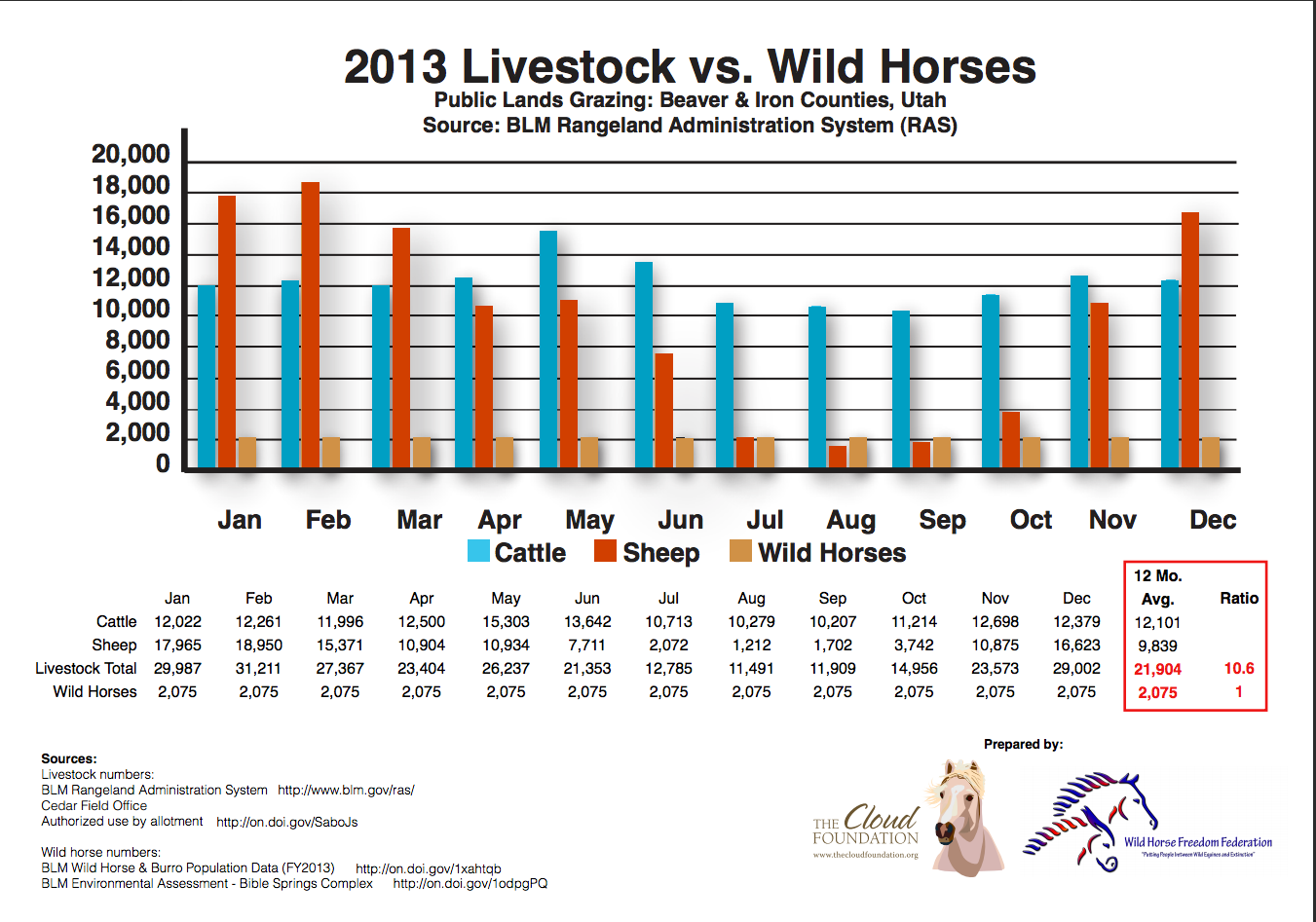
June 6, 2014 | For months, ranchers in Utah’s Iron and Beaver counties have been pressuring the Bureau of Land Management (BLM) to remove 697 out of 777 wild horses from public rangeland called the Bible Springs Complex.
What prompted them was a BLM request seeking voluntary reductions in livestock on public land suffering damage during the long drought. Faced with the loss of cheap forage for their cattle and sheep, the ranchers found a way to deflect the blame and economic burden.
Wild horses make an easy target; but that’s only as long as the BLM’s and the ranchers’ case for removal goes unexamined. The news media so far has done little probing into the issue—not in Utah, nor elsewhere ranchers lobby to get rid of wild horses.
Instead, the ranchers and BLM simply assert that the mustangs—and not privately owned livestock—are “overpopulating” and “overgrazing.” This claim is made without any scientific proof. Overgrazing as compared to what, exactly? Cattle and sheep? Neither the BLM nor the ranchers will provide data.
What is known is that the ranchers have nearly two million acres of grazing allotments in Iron and Beaver counties that overlap eight herd management areas (HMAs) where wild horses are protected. The four HMAs making up the Bible Springs Complex are just a fraction of the more than half-million acres where the wild horses (and private livestock) graze together under “multiple use” land policies. Another nearly million and a half acres of public lands provide further forage exclusively for cattle and sheep…(CONTINUED)
Click (HERE) to read the rest of the story on AlterNet


 To contact us: ppj1@hush.com, or call 320-281-0585 More










 The PPJ Gazette
This document has a comment period that ends in 58 days (05/11/2015) How To Comment